

“Scripture does have to agree with itself but it uses different words to describe where Jesus was crucified."


Joe Kovacs has tackled this question in his new book, "Reaching God Speed: Unlocking the Secret Broadcast Revealing the Mystery of Everything."
Kovacs begins by noting what many people believe is the entire story.

The New Testament describes the crucifixion of Jesus as taking place in Jerusalem.
The verses in Matthew 27:32-56, Mark 15:21-38 Luke 23:26-49 and John 19:16-37 describe Jesus as being brought to the "Place of a Skull.”
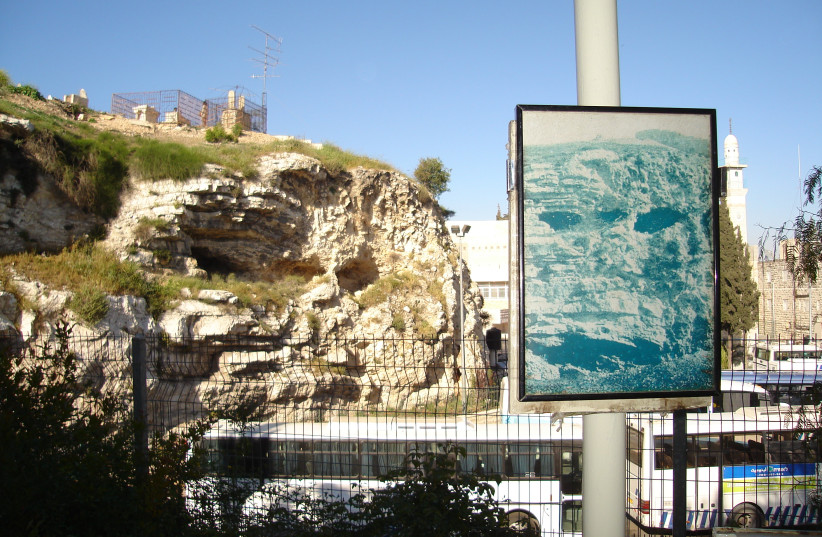
Most scholars accept these verses at face value and believe that Jesus was crucified at a site immediately outside Jerusalem's walls called Golgotha that was accessible to passers-by and observable from some distance away.
Eusebius of Caesarea, a fourth-century Greek historian of Christianity, identified its location only as being north of Mount Zion.
The name Golgotha is derived from Goolgolet, the Hebrew word for skull. Similarly, in Aramaic Golgotha means “place of the skull.” The Latin word for skull is calvaria, and in English, many Christians refer to the site of the crucifixion as Calvary.
This is supposedly a reference to either the skull-like appearance of the rock face and/or the presence of bones at the site.
The Gospel of John states there was a garden at Golgotha and an unused tomb owned by a prominent rich man, Joseph of Arimathea, into which Jesus’ body was placed. This tomb is believed by some to be a site known today as the Garden Tomb.
As Jesus had relatively few disciples at the time of his crucifixion, no church or landmark was raised at the site until the fourth century when Constantine ordered the construction of a basilica at the site he believed was Golgotha. This later became known as the Church of the Holy Sepulchre.
The authenticity of this site was questioned as it stands inside the walls of Jerusalem’s Old City. Archaeologists have uncovered remains of other walls that may have existed at the time of Jesus that would put the basilica outside the city walls.
As a result, there is some dispute over the precise location of events.
Though the consensus is that the crucifixion and subsequent burial and resurrection all took place in and around Jerusalem, another dilemma appears suddenly in the book of Revelations:
And their dead bodies shall lie in the street of the great city, which spiritually is called Sodom and Egypt, where also our Lord was crucified (KJV 11:8).