

Craig M White 2022 Version 1.0 (DRAFT) Where are the Levites today?
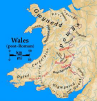


Who are the Welsh? Why do there appear to be two or three physical types that are different to each other, however minor (much like the Scots)? Can we trace them back to their true origins and initial geographic location? This article takes the position that most Welsh descend from Levi as do some of the Scots and others scattered throughout certain modern-day nations, the so-called ‘lost’ tribes of Israel. Attempts at proving this position will be undertaken by utilizing Bible prophecy, tribal names, the attributes of the Welsh as compared with the Levites and such like. Much of this comes down to plain common sense and obvious linkages that also can be supported by the historical record. Of course, this is not meant to be a history lesson or detailed information about Wales or the Welsh – that has been covered infinitum in hundreds of works. I leverage off these works for the purpose of this article. Nor is it meant to be a scientific, academic work of a hundred or more pages that few may want to read, would be too lengthy and circuitous and yet come to the same conclusions as a shorter article. As much as it is tempting to include huge amounts of data, such would be self-defeating and not assist in promulgating the message. On the other hand, an article that is too short would not give credence to the subject matter either. As most readers would know, the Levites are part of the tribes of Israel – a part of yet separate to the 12 tribes – a sort of 13th tribe.1 Their similarity to the Welsh is rather remarkable as we shall see. In fact, many within the British-Israel movement have noticed those similarities for over a century but a full treatise on the subject is yet to develop. It is not only the British-Israelites who subscribe to this belief, but also many within the Church of God community. In 1986 I wrote to the office of the local Church of God about this matter and the response is contained below:
“You also asked for information indicating that the Welsh people are descended from the tribe of Levi.
“I am not aware of any publications or reference sources that mention this, but because there are several similarities in traits between the Welsh and Levites, it is most likely that they are the one and same people. For example, like the Levites, the Welsh are natural singers. There are also many place names in Wales that appear to correspond with Levitical surnames as recorded in the Bible” (Letter to Craig White, 4 August 1986).2
To me this was a of interest and together with some information scattered among British-Israel literature I had read a decade earlier, it seemed to me that more information could be found and assembled into a meaningful article.
1 Many nations had 12 tribe arrangements around the world, and this seems to be a natural order. Refer to John Michell and Christine Rhone, Twelve Tribe Nations.
2 See also Surnames in Wales, Ireland, Cornwall Genealogy, Isle of Man by Penelope Christensen.
“During my recent reactivated research, I stumbled across a website with the following stated aims: “The Merrick project is to identify members of the Royal House of Llewellyn of Wales and associated ancestors … “the line of Merrick came from the linage of Merari right out of the Bible. It is a strong protestant line but with clear roots in the Hebrews of Israel and its 12 tribes. 1 Chronicles|6:19 The sons of Merari; Mahli, and Mushi. And these are the families of the Levites according to their fathers. 1 Chronicles|6:32 And they ministered before the dwelling place of the tabernacle of the congregation with singing, until Solomon had built the house of Yah in Jerusalem: and then they waited on their office according to their order. So, we can see from the DNA that a great deal of us can in fact find out WHO WE ARE and WHERE WE CAME FROM and know that the Genealogy and science line up to prove the facts. I am a LEVITE from the Tribe of Merari Daniel Merrick. I am Israel and an Heir to the promise by the adoption and restoration as promised in one of the oldest history books that mankind has, the Bible.” Daniel Merrick: www.familytreedna.com/groups/merrick/)
I found it rather amazing that this family in Wales found their connections with ancient Levi! I thought that perhaps there are more Welsh than one thinks who believe in this connection. Also, during my investigations, I stumbled across a booklet containing a sermon about the problems with monetary interest. It is titled The Lombard-Street lecturer’s late farewell sermon, answer’d: or, the Welsh Levite toss’d de novo. A dialogue between David J-nes and Dr. John Bastwick; and Lovewit and Fairman, two of his late parishioners. Addressed to the Bankers of Lombard-Street. A rather lengthy title, but not uncommon for publications of the 17th century. What struck me is that the author identifies himself as the “Welsh Levite”. I do not know why this is the case, but it does raise eyebrows and causes one to pause and wonder if some of the protestant ministry in Britain of that time considered themselves descendants of the Levites. As with other articles I have produced, much of my research is in storage, including notes (and highlighting of critical information in books and papers for additional use or quoting from) and therefore some articles are incomplete. I hope that someday I can use that research to ‘flesh’ out this and other articles to provide further justice to the subject matter.
As always, we must make sure that we do not get carried away with a simplistic approach, or that of the non-believers nowadays whose works are very helpful in their technical and scientific detail, but which can blur our research with peripheral detail.
ANCIENT LEVI

The location of the tribes in the Holy Land
Levi means “attached” or “joined” indicating the following according to Abarim Publications:
Let us commence with Levi’s birth which is recorded in the first book of the Bible: “Again she conceived and bore a son, and said, “Now this time my husband will be attached to me, because I have borne him three sons.” Therefore, his name was called Levi. And she conceived again and bore a son, and said, “This time I will praise the LORD.” Therefore, she called his name Judah. Then she ceased bearing.” (Gen 29:34-35).
“Etymology of the name Levi
There is some controversy about the etymology of the name Levi. BDB Theological Dictionary suggests that the name Levi was derived from the word Levite, instead of vice versa, and that the word Levite has to do with a Minaean word for priest. Another suggestion is that the name Levi (לוי) is derived from the name Leah ( לאה) and means Weary, rather than something else. HAW Theological Wordbook of the Old Testament disagrees with this kind of ‘strong disclaimers’ and (as does NOBSE Study Bible Name List) derives the name Levi from the verb לוה (lawa) meaning join, be joined. This is the verb that Leah uses when she names Levi, “Now this time my husband will be joined to me, because I have borne to him three sons” (Genesis 29:34): Excerpted from: Abarim Publications’ Biblical Dictionary לוה …
The verb לוה (lawa) means to join or to connect things; it’s a verb of building and it’s also the verb that lies at the heart of intelligence, cognition and logical deduction.
A specialized usage of this verb speaks of the joining of two ends via a circular motion of sorts. Nouns לויה (liwya a1) and ליה (loya) describe a wreath; a circular, coiled or twisted band of leaves or twigs. A third specialized usage of our verb speaks of borrowing and lending.
Levi Meaning. In an absolute sense, the name Levi means Joined or Coiler, but judging from the context that also produced his name, the meaning of Joined is preferred.
For a meaning of the name Levi, NOBSE Study Bible Name List reads Joined. (Jones’ Dictionary of Old Testament Proper Names offers the eloquent Adhesion. )
In the theocratic structure of Israel the Levites were the people who promoted social cohesion. They had no land of their own but were dispersed among the tribes, infusing all of them equally with the same education and thus forging a unified national identity across the clans. A similar function was assigned to the Celtic druids and the medieval European monks.” [last sentence emphasis mine] (www.abarim-publications.com/Meaning/Levi.html) It was a complete surprise to find that this Jewish publication draws a parallel with the Druids. We can thus interpret their name to equate to their role: to serve the Lord and Israel in Priestly and other duties.
In a sense they were on loan to the other tribes to educate them and to keep discipline. He was the third son of his mother Leah (daughter of Laban), and his brothers were Reuben, Judah, Issachar, Simeon, Zebulon. His half brothers were Naphtali and Dan (sons of Bilhah); Asher and Gad (sons of Zilpah); and Benjamin and Joseph (sons of Rachel). Twelve in all. Notice that the next to be born was Judah and these two brothers certainly have similar temperaments and are closely aligned, even in geographic proximity. The Levites were the religious leaders while Judah produced the political rulers and kingly line.
“Simeon and Levi are brothers; weapons of violence are their swords.
Let my soul come not into their council; O my glory, be not joined to their company. For in their anger they killed men, and in their willfulness they hamstrung oxen.
Cursed be their anger, for it is fierce, and their wrath, for it is cruel! I will divide them in Jacob and scatter them in Israel.” (Gen 49:5-7)
Simeon and Levi (and Judah) have similar characteristics – fierce and passionate. While there is some concentration of them in certain areas, they are also scattered due to their troublemaking and also for the need for Levitical teaching and leadership among the tribes of Israel (v 7). In this sense “scatter” is more like an ordered allocation of them among the tribes.
Prominent Levites in the Bible included Moses and Aaron, Elijah, Ezekiel, Jeremiah, Habakkuk, Haggai, Zechariah, John the Baptist.
In another prophecy we are told: “And of Levi he said, “Give to Levi your Thummim, and your Urim to your godly one, whom you tested at Massah, with whom you quarreled at the waters of Meribah; who said of his father and mother, ‘I regard them not’; he disowned his brothers and ignored his children. For they observed your word and kept your covenant. They shall teach Jacob your rules and Israel your law; they shall put incense before you and whole burnt offerings on your altar. Bless, O LORD, his substance, and accept the work of his hands; crush the loins of his adversaries, of those who hate him, that they rise not again.” (Deut 33:8-11).
This prophecy shows us the role of Levi that it was to continue on into the Millennium and not merely during the time of ancient Israel. Where are they located today?
Levis’s Background
The book of Genesis makes it clear that the Levites have a violent background – their nature is fierce and explosive as we have seen. Due to the rape of their sister Dinah by the Hivite, Shechem (Gen 34:1-2), they slaughtered a city.
They were able to do this via deception: they told the Shechem and his father Hamor that all the men of the city had to be circumcised to enable the marriage with Dinah to proceed (Gen 34:13-24).
Given the state that the men of the city were in after circumcision, this provided the ideal opportunity for the brothers to utilise their extreme behaviours on an entire city. While they slaughtered, the other brothers plundered (Gen 34:25-29).
The excuse to undertake such a horrific act was supposedly to protect Dinah’s honour, but this did not please their father who anticipated that surrounding peoples would react to the slaughter (Gen 34:30-31). As we have seen, the blessing of Jacob in Gen 49:5-7 reflects this: they would be scattered or allocated among the tribes (this does not rule out concentrations of these people in various places) with the Simeonites allocation within Judah (Josh 19:1-9).
Similarly, due to his nature, Levi’s descendants were not allocated a single tribal geographic area at that time, but instead were allocated among the tribes (Num 18:23-24; 35:1-8; Josh 21:1-45) – in this way they became the religious leaders and priesthood without a land allocation (Josh 13:14, 33; 14:3-4; 18:7). No land? No problem! God and the priesthood became their inheritance.
This Levitical allocation “out of the inheritance” of the tribes were 48 cities (Josh 21:3, 41-42) including the cities of refuge (Josh 21:13, 21-27, 32-38; Num 35:6). Instead of slaughtering indiscriminately, they now became the protectors of man slaughterers under certain circumstances.
But when it was necessary, their violent nature could be unleashed upon the apostate (Ex 32:25-29) in defence of the honor of God Himself.
The Levites held various offices such as that of judges, teachers (see Peter Leithart, “What is a Priest?”, Biblical Horizons, Jan 1992, pp. 3-4) and many of their duties are mentioned in Num 1:50; Deut 10:8; 33:10; IIChron 17:7-9; 35:3; Neh 8:7-9; Mal 2:4-7. In this way they redeemed themselves and, in a sense, also their forefather.
Their violent nature extended to the daily slaughter of animals as part of the sacrificial system and also to function as the guardians of the Tabernacle and Temple (Num 1:53) as sort of ‘warrior-priests’. They were to “work and keep” the sanctuary (Num 3:7-8; 8:26; 18:5-6).
While the nature of him and his descendants were violent (Gen 34:25-31), this could also be transferred to righteous wrath in service of God (Ex 32:26-28; Num 25:7-13; IIChron 23:1-9). They were therefore ideal for service in the ministerial and priestly capacity at the Tabernacle (Ex 38:21) and set aside for this purpose and for other offices of public service such as in the judiciary (Deut 17:9; Num 8:6, 10-15; IIChron 19:8, 11; Ezek 44:24 etc). The Gershonites and Merarites handled the sanctuary (Num 7:1-8) but not the Kohathites (v 8; 4:15; Deut 10:8; IISam 6:6 – they were not permitted to touch the holy things). Refer also to IChron 13:9-10; Josh 3:3, 6, 8, 17; 4:9-10, 16-18. Other duties included functioning as teachers and health inspectors (Deut 24:8; 31:9; 33:10; Mal 2:6; 3:7; IIChron 35:3; 17:7-9; Neh 8:7; Jer 2:8; 18:18; Ezek 44:23); and money collectors for the national income scheme (Num 18:24; IIChron 24:4-11).
Although young men or men of households were initially to be family priests (Ex 13:1-2, 16; 19:22-24; 22:29; 24:5; 34:20; Num 8:16-18; Deut 15:19-21; Ps 89:27), the Levites were given this special calling – as a bloodline of priests and religious servants (Num 3:12, 41, 45; 8:16-18) and recognised as men of God (Jud 17:8-13; 18:2-6) who remained strong during times of anarchy etc (Jud 17:6; 18:1; 19:1-2). As we have seen, the Levites were not numbered with Israel (Num 1:47-53) and had no inheritance in the farmlands (Num 2:17, 33; 26:62; Josh 14:3-4; 18:7; Deut 10:9).
But they seemed to be closely aligned with or associated with the ruling tribe of Judah and in fact, may have had proportionately more of their number dwelling within the Judaic tribal boundaries than amongst the other tribes (Jud 17:7; IIChron 30:25). Also, they were to be well looked after (Deut 12:12, 18-19; 14:27-29; 16:11, 14; 18:1-6; 26:11-13).
In summary, they were dispersed (in a controlled and organised way – an allocation) among the Israelitish tribes to teach them the Laws of God and to maintain discipline (Lev 25:32-34; Num 35:1-8; Josh 21:1-8, 41; Ezek 45:1). In Num 4:23 and 8:24 they are ordered to “come to duty” or to “do the work”.
On the surface this seems to be a general comment to undertake their Levitical duties, but in reality, it extends deeper: it refers to going to war (compare Num 1:3) – the verb tsaba is connected to the name YHWH Sabaoth or the Lord of Hosts. The sense we get is that the Levitical work around the Tabernacle, in teaching the Israelites and in violently putting down apostasy, was considered a sort of spiritual warfare. This is something a Christian would identify with (Matt 11:12; IICor 10:4; IITim 2:3). At times they kept faithful to God (Ex 32:26; Num 25:11-13; Deut 33:8-11; ISam 6:15; IISam 15:24; IKings 8:1-6). Yet at other times they let down and had to be purified (Ezra 9:1; IIChron 24:5; Neh 7:1; 11:20; 12:30; 13:28-30; Ezek 43:19; Zech 12;11-13; Mal 2:1-8; 3:3).
coming soon…..PART 2